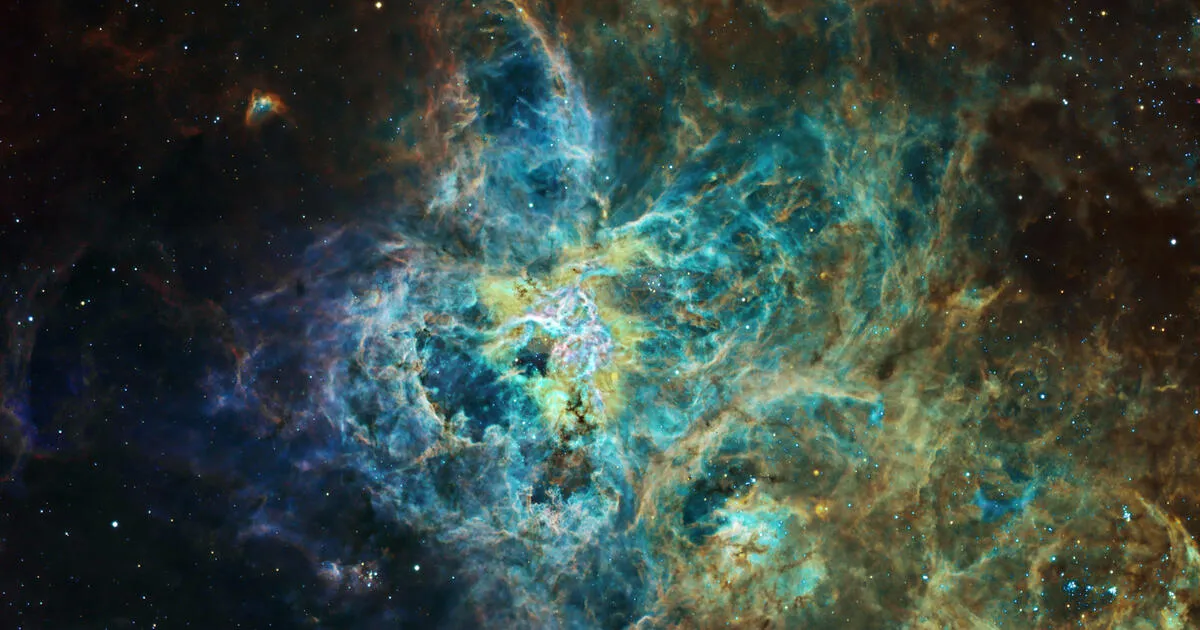
What is the Tarantula Nebula?
The Tarantula Nebula, also known as 30 Doradus, is a vast and dynamic region of ionized hydrogen gas in the Large Magellanic Cloud (LMC), a satellite galaxy of the Milky Way. It is one of the most active star-forming regions in the Local Group of galaxies, making it a fascinating target for astronomers. Its intricate structure, filled with bright stars, dark dust lanes, and energetic processes, provides a unique opportunity to study the life cycle of stars and the evolution of galaxies. Its significance lies not only in its visual beauty but also in the wealth of information it offers about the universe.
Location and Visibility
The Tarantula Nebula is located in the Large Magellanic Cloud (LMC), a dwarf galaxy about 160,000 light-years away from Earth. Due to its relatively close proximity, the LMC and the Tarantula Nebula are visible from the Southern Hemisphere, making it a prominent object in the night sky for observers in that region. While not visible to the naked eye, the nebula’s brightness makes it an excellent target for telescopes of all sizes, providing stunning views of its complex structure. Its location within the LMC offers an excellent vantage point for studying star formation in a galaxy different from our own.
Size and Distance

The Tarantula Nebula is an enormous structure, spanning approximately 1,000 light-years in diameter. This vast size means it is one of the largest and most active star-forming regions known in our galactic neighborhood. Its distance of 160,000 light-years allows astronomers to study the nebula in great detail, observing the processes of star birth and death with unprecedented clarity. The scale of the Tarantula Nebula provides a unique opportunity to understand the processes of stellar evolution on a grand scale.
What Are Nebulae?
Nebulae are vast clouds of gas and dust in space, serving as the nurseries where stars are born. These clouds are composed primarily of hydrogen and helium, with trace amounts of heavier elements. Nebulae can take on various shapes and colors, illuminated by the radiation from nearby stars, which causes the gas to glow. The Tarantula Nebula is a prime example of an emission nebula, where the intense ultraviolet radiation from young, massive stars excites the surrounding gas, causing it to glow. Studying nebulae helps scientists understand how stars form and how the elements are distributed throughout the universe.
Top 5 Discoveries About the Tarantula Nebula
Discovery 1 The Star Formation

One of the most significant discoveries about the Tarantula Nebula is its extremely active star formation rate. It’s a stellar nursery, birthing new stars at a rapid pace. Astronomers have identified numerous protostars and young, massive stars within the nebula, providing insights into the early stages of stellar evolution. This high rate of star formation makes the Tarantula Nebula a perfect natural laboratory for observing how stars are born, grow, and interact with their surroundings.
Discovery 2 The Massive Stars
The Tarantula Nebula is home to some of the most massive and luminous stars known, including the R136 cluster, a dense concentration of young, extremely hot stars. These massive stars have a profound impact on the surrounding nebula, emitting intense radiation and powerful stellar winds that shape the nebula’s structure. The study of these stars helps us understand the limits of stellar mass and the processes that govern the evolution of massive stars.
Discovery 3 The Supernova Remnant
The Tarantula Nebula contains the remnants of a supernova, a massive star that exploded at the end of its life. This supernova, known as SN 1987A, provided astronomers with a unique opportunity to study a supernova in detail. The observation of SN 1987A helped to confirm theories about the final stages of stellar evolution and the formation of heavy elements. Studying supernova remnants within the Tarantula Nebula continues to provide valuable insights into the life and death of massive stars.
Discovery 4 The Age of the Nebula

Estimating the age of the Tarantula Nebula is complex because it’s a region of continuous star formation. However, by studying the properties of the stars within the nebula, astronomers estimate that the nebula is relatively young, perhaps only a few million years old. It is an actively evolving system. The young age of the Tarantula Nebula makes it a unique environment for studying the initial conditions of star formation and the subsequent evolution of stars within a dynamic interstellar environment. It allows us to see the effects of star formation unfolding in real time.
Discovery 5 The Chemical Composition
The Tarantula Nebula’s chemical composition has provided valuable information about the early universe and the formation of heavy elements. Astronomers have observed that the nebula is enriched with heavier elements, produced in the cores of massive stars and dispersed into the surrounding interstellar medium through stellar winds and supernova explosions. These observations help us understand how the elements that make up the building blocks of planets and life are created and distributed throughout the universe. The study of the nebula’s chemical composition sheds light on the evolution of galaxies and the processes that recycle matter in space.
How Was the Tarantula Nebula Formed?
The Role of Supernova

Supernova explosions play a crucial role in shaping the Tarantula Nebula. These powerful events blast material from dying stars into space, creating expanding shock waves that compress the surrounding gas and dust. This compression can trigger the formation of new stars. Supernova remnants, such as those found within the Tarantula Nebula, are regions of intense energy and radiation, that heat and ionize the surrounding gas, contributing to the nebula’s complex structure and its vibrant appearance. They also enrich the interstellar medium with heavy elements.
The Impact of Stellar Winds
Massive stars within the Tarantula Nebula emit powerful stellar winds, streams of charged particles that flow outwards from the star’s surface. These winds collide with the surrounding gas and dust, carving out cavities and creating complex structures within the nebula. The interaction of stellar winds with the interstellar medium can also trigger the formation of new stars. The combined effect of stellar winds and supernova explosions shapes the dynamic environment of the Tarantula Nebula, influencing its evolution and the ongoing processes of star formation.
What Can We Learn from the Tarantula Nebula?
Understanding Star Formation

The Tarantula Nebula provides a unique laboratory for studying star formation. By observing the various stages of star birth, from the collapse of gas clouds to the formation of protostars and the ignition of nuclear fusion, astronomers can gain a comprehensive understanding of how stars are born. Studying the Tarantula Nebula allows them to investigate the conditions under which stars form, the impact of stellar feedback on star formation, and the properties of young stellar objects.
Studying Galactic Evolution
The Tarantula Nebula is a valuable tool for studying galactic evolution. By analyzing the nebula’s chemical composition, star formation rate, and the properties of its massive stars, astronomers can gain insights into how galaxies form and evolve over billions of years. Observations of the Tarantula Nebula provide information about the distribution of elements, the rate of star formation, and the impact of stellar feedback on the interstellar medium, all of which contribute to a better understanding of the life cycle of galaxies.
Future Exploration
Future exploration of the Tarantula Nebula will focus on using advanced telescopes to observe the nebula in greater detail, across a broader range of wavelengths. New instruments will allow astronomers to study the nebula’s structure, composition, and dynamics with unprecedented precision. These observations will help to unravel the mysteries of star formation, the evolution of massive stars, and the impact of these processes on galactic environments. The Tarantula Nebula will continue to be a key target for astronomers, providing vital clues to understanding the universe.